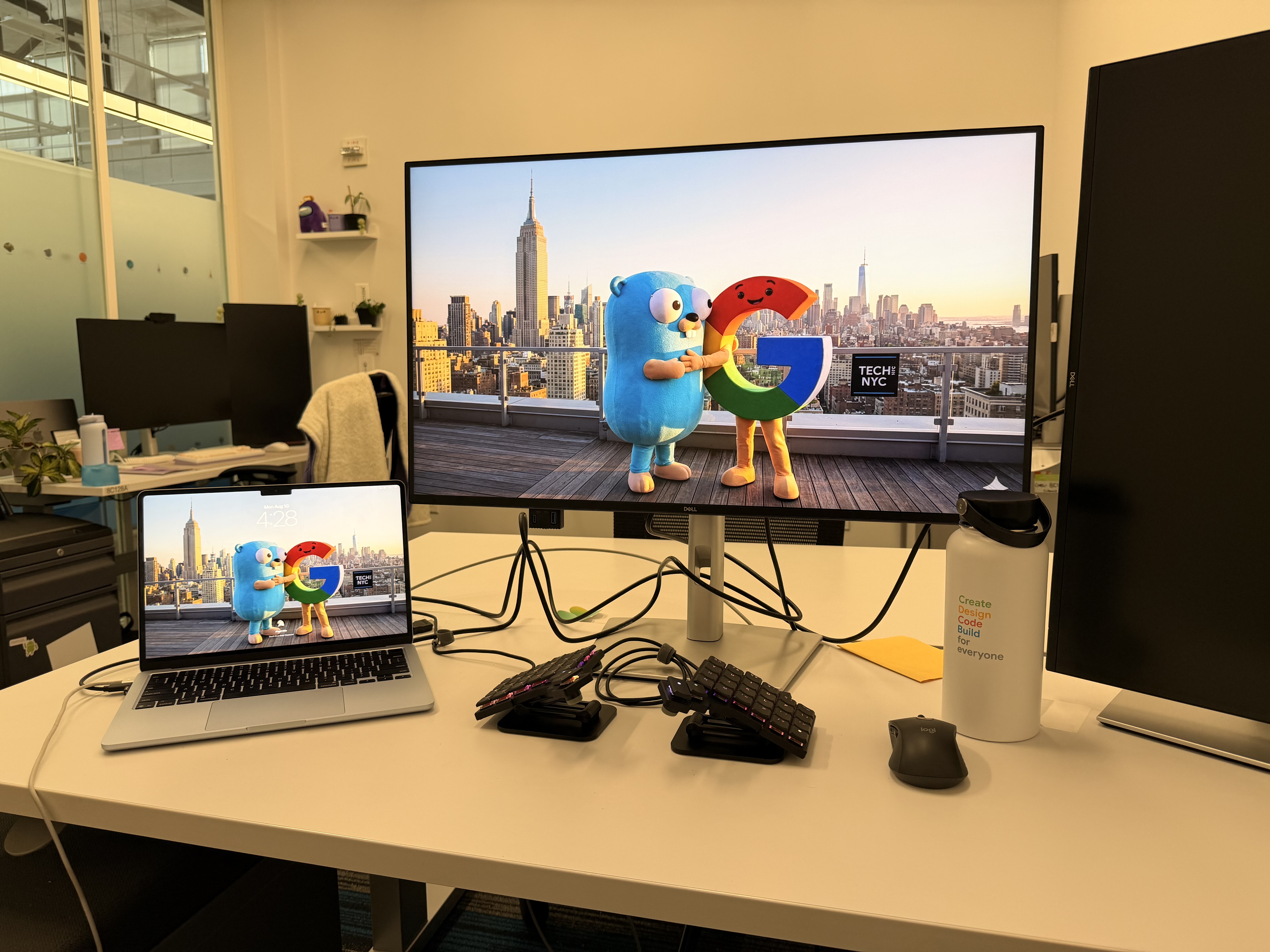
I spent my first week at Google mostly confused. New codebase, new scale, and a project that didn't exist yet. By the end of the summer that confusion turned into 3,000 lines of Go running against Google's fleet.
My Team
My team consisted of just 2 other people, my host Lauren and co-host Ethan. Both incredibly charming and smart people. On my first day I just knew they were gonna be great people, and once they handed me an Among Us packet with little figures in it, I was so happy to get a team with other nerds like me.
They both taught me so much during my time there, but Ethan taught me the most life lessons. I remember during my final presentation, he told me I was really well spoken and had great depth to my ability to talk technically, to which I said "I usually feel like I do poorly in these talks so thank you." He responded, "You only say that cause you see the flaws in the way you speak. In most situations you should be able to see the problem and improve yourself to catch it. The fact that you're able to speak and notice your failures to articulate yourself proves that not only are you already a good speaker, but that you are ever improving. Most people speak and see nothing wrong with their language. You are climbing."
I remember my eyes widening at the new perspective. He gave me great advice throughout my internship but that was the first time someone reframed self-critique as a skill instead of a flaw for me.
Data Corruption Management
My team, DCM, existed for one core reason: use machine learning to detect CPU silent-data corruption (SDC) across Google's data center fleet. We used a Random Forest Regression model that had access to checksum integrity reports, kernel crashes, and more, to predict if a CPU was going through an SDC event. My team also managed the reporting libraries that fed checksum integrity reports to the model, and when I joined, this library only existed for C++ and Java clients.
They gave me the task of extending it to a new language, Golang or Python, and then looking for integration candidates for my library.
My Project
My project initially involved a lot of research, since I couldn't choose both, I had to learn which language was better for my team to integrate sooner with. We ended up going with Golang, because the SDK I was working with was much more developed, and Golang had access to much better concurrency, compilation speed, and a much greater fleet reach.
The Build
Building the library itself was actually quite simple, especially since I had access to the other libraries. It was very easy to work with AI and go back and forth for porting the library into Golang while following my design doc and making architectural decisions that were better for Golang. The fun part was really thinking about the scale of my design, and its lower level counterparts. I had to work a lot with concurrency, making sure my library could handle millions of threads calling onto it, learning a lot about Golang context handling, and making sure we were extremely easy to integrate with.
One Bump
The biggest bump I had was learning that Golang itself doesn't come with its own "GetCPUID" function, so I had to come up with a way around that in my design. I ended up building a CGO wrapper - basically a Golang function that could call a C function to retrieve the CPU ID and bring it back up to my library without trapping the Goroutine and causing any lag spike for the hardware.
My Impact
When my library was done, it was over 3,000 lines of fresh code, ready to integrate into teams across Google. My team today is working on integrating with a major team at Google, so I know my library will be reaching millions of machines across the fleet, and I'm extremely proud of the impact I was able to make for my team.
Side Projects
Best believe I was going to extend my reach across more of my team where I could. A few things I got to work on along the way:
AI Week
I got to host an Agentic Engineering learning session with my team so we could get up to speed on how fast software engineering is changing outside Google. It inspired my team to have an AI Week, where we updated all our libraries with agent context and set up a very detailed PR review agent just for our team.
Serving Model Metrics
Our model's serving pipeline was taking longer than usual with no observability into why, so I added latency timing metrics across data collection, prediction, and SHAP value explanations, and built a dashboard so my team could actually see where the time was going.
Cell Quota
There was a past incident where the model misfired and evicted a batch of perfectly healthy machines. So I added a safeguard to the eviction pipeline that caps how many machines can be pulled from a cell at once. A small change, but it mattered to my team since Google needs all the machines it can get.
Looking Back
My summer at Google was truly one of a kind. Google is a place I've always dreamt of working at since I started Computer Science, and with a lot of hard work, I finally got a chance to experience what it's like to work at a place with true scale. I write this incredibly proud of myself, and honored that I got to work at a place where the engineering bar is constantly pushed.
What I loved about my project was how much in the weeds it was. I had to learn a lot about our previous C++ and Java libraries, what "good data" looked like for our model, and at a lower level, CPU infra, accelerators, and even more. This was the first time I got to design for scale where "edge case" means millions of machines, not a few thousand, and it confirmed that a mix of software with infra-level work is where I want to keep building.
I would love to come back to Google if given the chance. It was an incredible experience, and so fun eating with my team every day. I got really close to them, and hugging them when I left felt like losing a close friend.
My Next Venture
As you know, I'll be joining Hg Catalyst in the fall, getting close with the frontier of AI delivery and learning state of the art concepts. Hopefully I get to meet some companies working with LLM engineering and other major AI companies in the space!
I'll also be competing at the AI Databricks Hackathon in NYC this fall, which is taking place on my campus, funny enough.
Thanks for reading! :>